
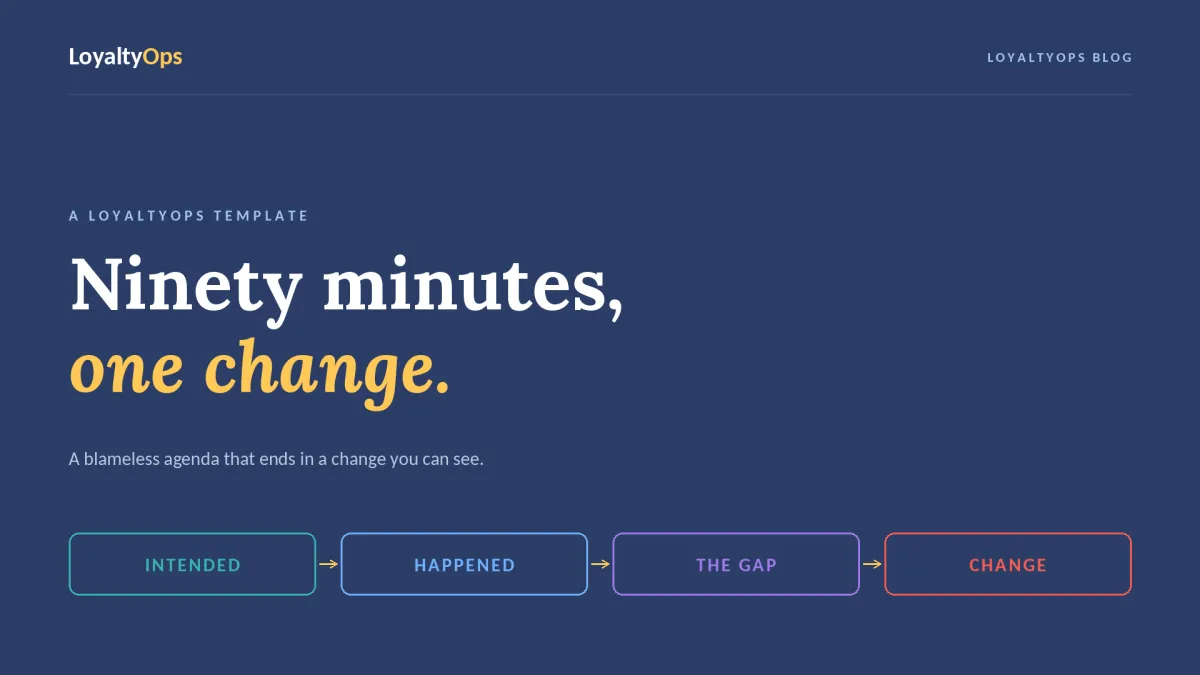
The After Action Review Agenda Template (Free)
The After Action Review Agenda Template: A Blameless 90-Minute Review
If your team finishes projects and moves straight on, the lessons stay inside those projects and the same problems come back. The fix is a short, blameless review that ends in a change you can see. The free After Action Review Agenda Template gives you everything to run one. Here's what's inside and how to use it this week.
What is the After Action Review Agenda Template?
It's a short LoyaltyOps agenda template for running an after action review — a structured, blameless, ninety-minute review you hold after something finishes. It turns a completed project into at least one change the team actually makes, and it shares the lesson with the teams it affects. It gives you the timed agenda, the roles, a one-page worksheet, examples for writing a change you can see, and the steps for documenting and sharing it.
It's built for the leader whose team keeps solving the same problems twice. You can run your first review off it this week.
What's inside the template?
The template walks through the whole review:
The 90-minute agenda — seven timed steps, in order, from open to close.
The two roles — facilitator and scribe, kept separate, plus an AAR steward.
The before-the-meeting prep — what to gather and who to invite.
The one-page worksheet — the scribe fills it in as you go.
Weak-versus-strong examples — how to write a change you'd actually see.
Document and share — the steps that get the lesson to the teams it affects.
The 90-minute agenda
The agenda gives each part of the review a fixed time, so the ninety minutes go to learning rather than losing focus:
Open (5 min) — name it as a blameless review, name the facilitator and scribe, and set the one rule: leave with at least one change.
What we expected (10 min) — the goal, the assumptions, and what success looked like.
What actually happened (15 min) — facts and observable outcomes, as a timeline.
The signals we saw (10 min) — the early signs, and when the team first sensed something was off.
What we could have done differently (15 min) — where the gap was, in the system and the process.
What we learned, and what to keep (15 min) — the patterns to carry forward.
What we'll change, and who owns it (15 min) — one to three observable changes, each with an owner and a date.
Close, document, and share (5 min) — confirm the change, where it's recorded, and who needs to hear it.
The two roles, and the steward
The template names two roles kept with different people: a facilitator who runs the agenda and keeps it blameless, and a scribe who captures the decisions, changes, and owners. It also names an AAR steward — one person who owns AARs over time, storing them and keeping them accessible. Separating the roles keeps the conversation moving and makes sure nothing gets lost.
The one-page worksheet
The heart of the template is a single page the scribe fills in as the review runs. It opens with the context — what the project was, the hypothesis you tested, and what you did — so that anyone, even someone in another department, can pick up the page later and understand it. Then it captures the review itself: what you expected, what happened in facts, the signals, the gap, what to keep, and the change you'll make, with an owner, a date, where it's documented, and who it's shared with. If it isn't written down, it won't stick, and it won't reach anyone else.
Weak vs strong: making the change observable
The template's most useful page is the one that shows the difference between a change and a sentiment, because this is where most reviews fail. A weak change sounds fine and does nothing. A strong change is something you'd actually see happening.
Weak: "Communicate better." "Be more careful." "Plan earlier."
Strong: "Escalate a timeline risk within twenty-four hours." "Write down cross-functional decisions the same day."
The test: would you actually see it happening?
Keep the list to one to three changes, each with a named owner and a date, because too many at once means none of them sticks.
Document and share
A review that stays with the people who were there only helps those people, so the template includes the steps that get the lesson out. The scribe finalizes the notes and the steward stores them in one shared place where the team can find them. The notes, with the change, the owner, and the date, go to everyone who attended. And the bigger lessons get written into a short briefing and sent to the cross-functional teams they affect, sometimes in a short session when a lesson touches several teams. Keeping every review in one shared place means the next team facing the same thing is one search away.
How to run it this week
Pick the last thing your team finished, good or bad. Name a facilitator and a scribe, gather the facts and the timeline, and book ninety minutes with only the people the learning needs. Run the agenda off the page, and leave with one change that's owned, written down, and shared. One review, with one change owned and recorded, is the whole habit starting.
Who is the template for?
It's for the leader whose team keeps relearning the same lessons and wants finished work to make the business smarter, not just busier. If projects wrap and everyone moves on before the lesson is captured, the template gives you a structured, low-effort way to turn each one into a change the team makes. It isn't a heavy process; it's ninety minutes and a page.
Get the After Action Review Agenda Template
Turn your next finished project into one change you can see. → Download the free After Action Review Agenda Template
Pick the last thing your team finished, run a review off the agenda, and leave with one change that's owned, written down, and shared. That single review is how you stop paying for the same lesson twice.
→ Get the template: loyaltyops.com/after-action-review
FAQ
Is the After Action Review Agenda Template really free?
Yes. It's a free download at loyaltyops.com/after-action-review, with no course to buy. You can run your first review off it this week.
What will I get?
The timed ninety-minute agenda, the two roles plus the steward, the before-the-meeting prep, a one-page worksheet the scribe fills in as you go, weak-versus-strong examples for writing an observable change, and the steps for documenting and sharing the lesson.
How long does an after action review take?
About ninety minutes, run on the timed agenda in the template. The prep — gathering the facts and the timeline and sending the worksheet ahead — happens before, so the ninety minutes go to learning and deciding on the change.
Do I need special training to run one?
No. Name a facilitator to run the agenda and keep it blameless, and a scribe to take notes, and follow the page. The structure does most of the work; it keeps the review on the system and makes sure you leave with a change you can see.
How is this different from a retrospective or post-mortem?
It's a blameless review that always ends in an observable change and a shared lesson, rather than a discussion that ends in insight. The fixed agenda, the two roles, and the "would you see it happening" test are what make an AAR change something instead of just naming it.