
Why the Work Keeps Coming Back to You: 4 Gaps
Why the Work Keeps Coming Back to You: The Four Gaps That Send It Back
You brought people in so the work would stop running through you. For a while it helped. Then the same things started coming back to your desk, and you became the person the whole team relies on to catch what falls. If you've ever wondered why the work keeps coming back to you even though you hired good people, the answer is more specific than it feels, and it points straight at the fix.
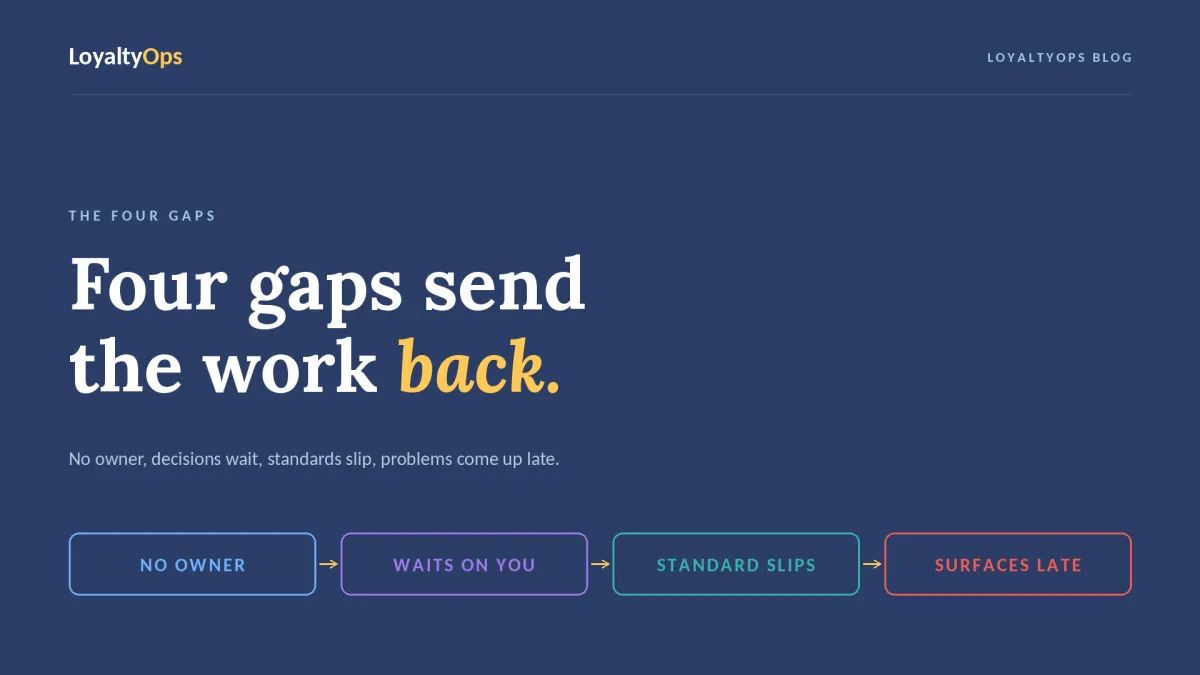
The work comes back through four specific gaps in how your team operates. Name the gap, build the one standard behind it, and that stream of returning work stops. Here's the full picture.
Why does the work keep coming back to you?
Your business grew, the team grew, and the way the team works together didn't grow with them. That's the short version.
Operations are the clear standards for how your team actually works day to day: how a decision gets made, how a problem gets raised, and how work moves from one person to the next. When those standards are clear and shared, the work stays where you hand it. When they aren't, it comes back to the one person the whole team can count on, and that person is you.
The reason is that the standards for how your team works are still living in your head. When the business was small, they traveled through proximity and conversation, and the team picked them up because they were around while you set them. As the team grew, the standards stayed where they were, and the way the team works together never got built into something the team can use without you. The work comes back because the operations haven't caught up to the size of the business.
Why hiring, meetings, and tools don't stop it
Most leaders try the same three responses first, and each one leaves the actual cause in place.
Hiring more people brings strong people into the same way of working, and within a quarter the work moves through the team the way it always has. More meetings and status updates give you more visibility into the work coming back, and visibility on its own doesn't change what sends it back. New tools organize the work, but a tool can't decide who owns a decision or keep a standard the team hasn't built.
Each response is reasonable, and each one leaves the missing standard exactly where it was. That's the clue worth sitting with: if effort and talent and software haven't fixed it, the cause is how the team operates, and that's a different thing to build.
The four gaps that send work back
When you look closely at what returns, it returns through four gaps. Each one is a standard the team doesn't have yet.
No one owns it across team lines
When work moves between teams, no single person owns it end to end. It stalls at the handoff, and it comes back to you because you're the only point both teams share. The standard that stops it names one owner for the whole path, not one owner per team, so the work has someone accountable the entire way through.
Decisions wait for you
The team doesn't have what it needs to decide, so the decision comes up to you when it could be made closer to the work. The standard that stops it is clear decision rights: who owns which decisions, and what they need in hand to decide without you. When the team knows the decisions are theirs, they stop bringing them back up.
Standards don't hold
What you set in the meeting isn't built into how the work runs, so it slips by the end of the week. The standard that stops it turns a spoken expectation into a written, shared way of working, so it shows up the same when you aren't in the room. A standard the team can see and use is one that survives past Friday.
Problems surface late
Issues reach you after they've grown, because nothing brings them up early where the work happens. The standard that stops it builds a path for problems to come up at the source, while they're still small and cheap to fix. When raising an issue early is normal and safe, you stop hearing about problems only once they're expensive.
Each gap is a standard the team is missing, and each missing standard sends its own kind of work back to you. That's why the work can feel relentless: it's not one problem, it's up to four, each with a different fix.
How do you find the gap costing you the most?
You don't have to build all four standards at once, and you shouldn't try. The fastest way to see your own pattern is to track it for a week.
Every time something you thought was handled comes back to you, write down what it was and mark which of the four gaps it came through: no owner, waited on you, standard slipped, or surfaced late. At the end of the week, the gap with the most marks is the one costing you the most time, and the one standard behind it is the first operation to build. That single record turns a vague feeling of being overloaded into a clear, specific place to start.
How this connects to the Leadership Operating Flywheel
The four gaps aren't random. Each one is a stage of the Leadership Operating Flywheel, the four-stage system every team runs on. Decisions waiting for you is a weak Commit stage. Problems reaching you late is a weak Collect stage. Standards that don't survive the week are a weak Communicate stage. Work that stalls between teams shows up when ownership and communication both run thin.
So the work coming back to you is really a symptom, and the Flywheel is the map underneath it. Fixing the gap that sends the most work back is the same as building the weakest stage of your Flywheel first, which is why this one change tends to free up the largest part of your week.
What changes when the work stops coming back
When you build the missing standards, the difference shows up quickly. The work stays done once it's handed off, because the standard for the handoff is clear. Decisions get made closer to the work, so fewer come up to you. What you set is built into how the work runs, so it shows up the same when you aren't in the room. Problems come up early, while they're still small. And the hours you spent catching what came back go to the work only you can do.
You stop being the safety net the whole team relies on, and your time goes back to building the business.
Download the free field guide
We put this into a short field guide, Why the Work Keeps Coming Back to You. It walks through all four gaps, includes the one-week comeback log so you can find your own pattern, and gives you the one standard to build next.
→ Download the free guide: loyaltyops.com/work-comes-back
If you want to build these standards with a room of leaders working through the same change, that's the work inside the Leaders Mastermind (loyaltyops.com/leaders).
FAQ
Why does the work keep coming back to me even though I hired good people?
Because the standards for how your team works still live in your head instead of in how the team operates. Capable people return work when they don't have the clear owner, decision rights, or shared standard they need to keep it. The cause is the operations, not the people.
What are the four gaps that send work back?
No one owns it across team lines, decisions wait for you, standards don't hold, and problems surface late. Each gap is a standard the team doesn't have yet, and each sends a different kind of work back to your desk.
Which gap should I fix first?
The one costing you the most time. Track what comes back for a week, mark which gap each item came through, and build the one standard behind your most common gap first.
Is this the same as reverse delegation?
Reverse delegation is the symptom, the work traveling back up to you. The four gaps are the causes underneath it. Fixing the gaps is how you stop the reverse delegation for good, rather than pushing the work back down each time it returns.
How does this fit with the Leadership Operating Flywheel?
Each gap maps to a stage of the Flywheel: decisions waiting for you is a weak Commit stage, late problems are a weak Collect stage, and standards that slip are a weak Communicate stage. Stopping the work from coming back is the same as building your weakest Flywheel stage first.