
Why Your Performance Reviews Change Nothing
Why Your Performance Reviews Change Nothing (and How to Fix Them)
Once a quarter, or once a year, you sit down for the performance conversation. You come in with your read on how things went. The other person comes in a little braced, ready to defend. The hour gets spent re-arguing the past, both of you leave with a few vague intentions, and by next quarter you're looking at the same problems, the same surprises, and the same conversation. The review happened. Nothing changed.
It's easy to conclude that reviews just don't work, or that this particular person won't take feedback. Usually the truth is more useful than either. Here's why the performance conversation so often changes nothing, and the fix that makes it actually move someone.
Why don't performance reviews work?
Because of the order they happen in. A typical review crams two very different things — looking honestly at the past and deciding what improves next — into a single hour, in the wrong sequence. Your feedback arrives first, as a verdict the person didn't see coming, and improvement gets tacked on at the end and assumed rather than chosen. The design almost guarantees a defensive conversation and a vague ending.
That's why even well-meaning reviews produce no change. It isn't the manager's intentions or the employee's attitude. It's that the conversation is built in a shape that produces bracing and defensiveness instead of reflection and change.
A braced person doesn't change
Here's the part that matters most. When someone walks into a room expecting to be judged, they spend the hour protecting themselves, not thinking about how to get better. Every piece of feedback becomes something to explain away. That's not a character flaw; it's how anyone responds to a surprise verdict about their work.
And a braced person doesn't change. Real change asks someone to look squarely at what didn't go well and decide to do something differently, and no one does that while defending themselves. So the more the conversation feels like a judgment, the less it produces the thing it's for.
Reflection and feedback are in the wrong order
Notice what the standard review asks the person to do: hear your assessment and reflect on their own performance at the same moment, in front of you. Those two things work against each other. Honest reflection needs a little space and safety; reacting to feedback in real time offers neither.
When you flip the order and let the person reflect first, on their own, the whole conversation feels different. They arrive having already thought about what went well and what didn't, so your conversation is two people comparing notes instead of one person delivering a verdict and the other bracing against it.
It isn't that your people don't want to grow
None of this means your team is allergic to feedback or coasting. Committed people leave reviews unchanged all the time, because the conversation never gave them a calm moment to reflect or a clear decision to make. When a review ends in "let's communicate better next quarter," the person isn't refusing to improve. They were never handed anything specific to improve.
That's good news, because a badly ordered conversation is far easier to fix than a motivation problem. You don't need a more coachable team. You need a performance conversation built in the right order.
The fix: reflect first, then align, then decide
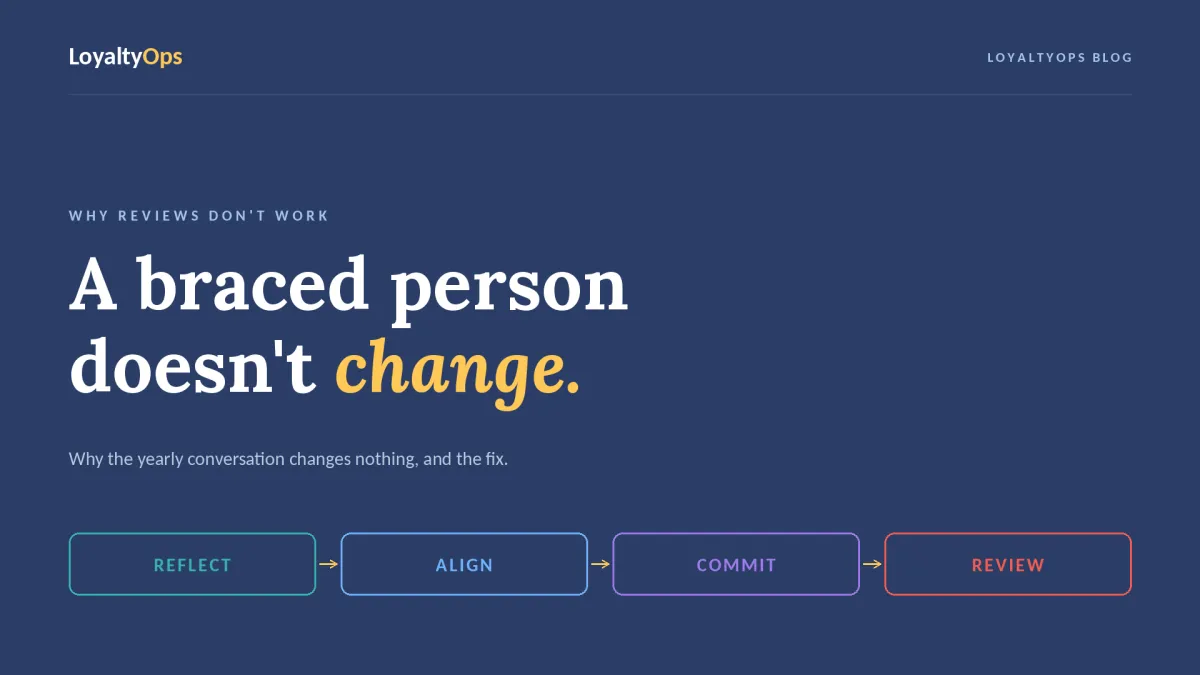
The change is to stop running reflection and feedback as one tense hour and split them into a sequence. First, the person reflects on the quarter on their own, honestly, before any conversation. Then you align together, comparing what each of you saw and adjusting. Then they commit to a small number of specific changes for the next ninety days.
Run in that order, the conversation stays calm, because the person arrives ready to talk rather than ready to defend. And it ends in a decision, not a feeling, because the last step is choosing what changes, not just discussing how it went.
Make the change a behavior you'd actually see
The other half of the fix is what the person commits to. "Be more strategic" and "be more careful" fail for the same reason "communicate better" fails: you can't see them, so no one can practice them or tell whether they happened. A real change is a specific, observable behavior, like "block two ninety-minute strategy sessions on my calendar each week." You'd actually see it happening.
Keep it to two or three, because more than that splits attention and none of them sticks. A short list of behaviors a person chose themselves is what turns a nice conversation into a quarter that's actually different.
How do you start this quarter?
Don't overhaul anything. For the next review, send the person a short reflection to fill in on their own a day or two ahead: what went well, what felt harder than it should have, and how they operated, not just what they finished. Then use the meeting to compare views and agree on one or two behaviors they'll practice for the next ninety days.
One conversation run in that order will feel different from every review before it, because the person shows up thinking instead of defending. Do it every quarter and improvement compounds, because each ninety days builds on the last.
Fix the order of your next performance conversation
If your reviews change nothing, the fix isn't a more coachable team, it's a conversation built in the right order. Our free Quarterly Performance Cadence Template puts reflection before feedback and ends in two or three real changes for the quarter ahead, with a self-reflection worksheet, strong-versus-weak behavior examples, and an alignment page.
→ Download the free Quarterly Performance Cadence Template: loyaltyops.com/quarterly-cadence
FAQ
Why don't performance reviews work?
Most reviews change nothing because they're in the wrong order: feedback and reflection get crammed into one hour, the feedback arrives as a surprise verdict, and improvement is tacked on at the end. A person braced for judgment spends the hour defending, not reflecting, so nothing changes. Reflecting first, then aligning, then committing to specific changes fixes that.
How do I make performance reviews actually improve performance?
Split the conversation into a sequence. Have the person reflect on the quarter on their own first, then align together, then commit to two or three observable behaviors for the next ninety days. Reflection before feedback keeps it calm, and ending in specific behaviors — not vague intentions — is what makes the next quarter different.
Why does my team dread performance reviews?
Because a standard review feels like a verdict delivered in real time, which puts anyone on the defensive. When people reflect on their own first and the meeting is about comparing views and choosing what changes next, the conversation stops feeling like a judgment and the dread eases.
Are annual reviews or quarterly reviews better?
A shorter cycle helps, because improvement chosen every ninety days compounds and stays relevant, while a once-a-year verdict is easy to brace against and forget. But frequency alone isn't the fix — the order matters more. A quarterly conversation run reflection-first beats a more frequent one still built as a surprise verdict.
What should someone actually commit to change?
Two or three observable behaviors, not outcomes or traits. "Be more strategic" isn't observable; "block two ninety-minute strategy sessions each week" is. Behaviors are the part a person can actually control and practice, and capping the list at two or three keeps each one from getting lost.