
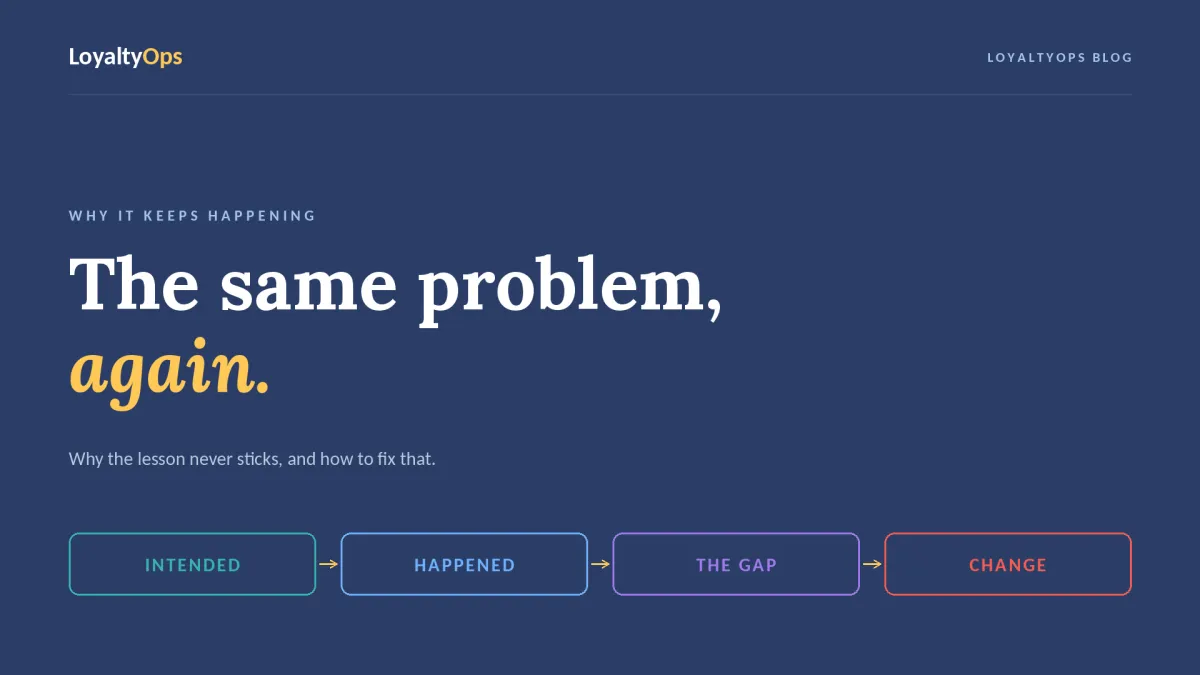
Why Your Team Keeps Making the Same Mistakes
Why Your Team Keeps Making the Same Mistakes (and How to Stop)
You've seen this one before. A problem you fixed last quarter is back, and the team is working through it again from scratch, as if the first time never happened. A mistake you thought was behind you returns in a slightly new outfit. The same kind of surprise shows up at the same stage of the same kind of project. It's the specific frustration of watching capable people relearn a lesson the business already paid for once.
It's tempting to read that as carelessness, or as a team that doesn't retain anything. Usually it's neither. Here's why the same problems keep coming back, and the change that actually stops them.
Why does my team keep making the same mistakes?
Because the lesson from the last time never became a change. A project wraps, the team takes a breath, and everyone moves straight to the next thing. Whatever the project could have taught you stays inside it, uncaptured, and an uncaptured lesson can't stop anything. So the next team to hit the same situation starts with the same blank page and makes the same call.
Experience only prevents a mistake if it's turned into something the team does differently next time. Left as a memory in one or two people's heads, it fades, those people move on or get busy, and the mistake is free to happen again. The problem isn't that your team doesn't learn. It's that the learning has nowhere to go.
The debrief that changed nothing
Maybe you already hold a debrief, or a post-mortem, after the big ones. That's the right instinct, and most debriefs still change nothing, for two reasons.
The first is that they turn into blame. The conversation quietly becomes about who dropped the thing, everyone gets defensive, and the real causes never come out because no one wants to be the example. The second is that they turn into storytelling. Everyone recounts what happened, nods, feels productive, and leaves without deciding to do a single thing differently. A good discussion feels like progress, and on its own it changes nothing.
"Communicate better" isn't a change
Even debriefs that reach a takeaway usually reach the wrong kind. "Communicate better." "Be more careful." "Plan earlier." They sound reasonable, and not one of them tells anyone what to actually do differently on Monday morning. A takeaway you can't act on is just a nicer way of hoping.
That's the quiet reason the same mistakes repeat even on teams that do reflect. The reflection produces insight, and insight isn't a change. A change is something specific enough that you'd see it happening: "escalate a timeline risk within twenty-four hours," "write down cross-functional decisions the same day." If you can picture someone doing it, it's a change. If you can't, it's a sentiment.
It isn't that your team doesn't care
None of this means your people are careless. Smart, committed teams repeat mistakes all the time, because the fix was never built into how they work. When a lesson lives only in memory and the debrief ends in a feeling, the next mistake isn't a sign anyone failed. It's the predictable result of a lesson that had nowhere to go.
That's good news, because a missing habit is far easier to fix than a motivation problem. You don't need a more careful team. You need a way to turn what a project taught you into a change the team actually makes.
The fix: end with one change you can see
The change is a small shift in how you close out work. Instead of finishing a project and moving on, you run a short, blameless review that ends in at least one change you can see, with a named owner and a date. Not a discussion that ends in a feeling. A review that ends in a decision.
Keep it to one to three changes, because too many at once means none of them sticks. Keep it on the system and the process, not on the person, so people can speak plainly about what actually happened. And write the change down, because a change that isn't recorded quietly reverts to the old way by the next busy week.
And make sure the lesson reaches other teams
There's one more step that stops a fixed problem from reappearing somewhere else. Once you've named the change, make sure it reaches the other teams who'll face the same thing. A lesson that stays with the people who were in the review only helps those people. Written down and sent to the teams it affects, it helps the whole business the next time.
This is the difference between a team that gets a little better after every project and one that keeps paying for the same lesson. The learning only helps if it reaches the people who need it.
How do you start this week?
Pick the last thing your team finished, good or bad. Book ninety minutes, name someone to run it and someone to take notes, and go through what you expected, what actually happened, and where the gap was. Then, before anyone leaves, name one change you'd actually see happening, give it an owner and a date, and write it down.
One review, with one change owned and recorded, is the whole habit starting. Do it a few times and the same problems stop coming back, because the team finally does something different with what it learns.
Turn your next finished project into one real change
If the same problems keep coming back, the fix isn't a more careful team, it's a way to turn what a project taught you into a change the team makes. Our free After Action Review Agenda Template gives you a blameless, ninety-minute agenda that ends in one change you can see, owned, written down, and shared.
→ Download the free After Action Review Agenda Template: loyaltyops.com/after-action-review
FAQ
Why does my team keep making the same mistakes?
Usually because the lesson from last time never became a change. A project ends, everyone moves on, and the learning stays uncaptured in a few people's heads, where it fades. The next team hits the same situation with no record of what was learned, so they make the same call. Ending each project with one recorded change is what stops the repeat.
Why don't our post-mortems fix anything?
Most debriefs change nothing because they turn into blame or storytelling and end with takeaways too vague to act on, like "communicate better." A review only prevents the next mistake if it ends in a specific change you'd actually see happening, with an owner and a date, and the lesson reaches the teams it affects.
Isn't "communicate better" a lesson?
It's an insight, not a change. Insight is a feeling of understanding; a change is a specific action. "Communicate better" doesn't tell anyone what to do differently, while "escalate a timeline risk within twenty-four hours" does. The test is whether you'd actually see it happening.
How do I stop my team repeating mistakes without blaming anyone?
Run the review on the system and the process, not the person. Ask what part of the process or the handoff contributed, keep it to observable facts, and interrupt blame when it starts. People speak honestly when it's clearly safe, and honest reviews are the ones that produce real changes.
How often should we review finished work?
Run a short review after anything worth learning from — a finished project, a client engagement, a missed goal, or a big decision. It doesn't need to be every task; it needs to be consistent enough that the team expects to close out real work with a change, not just a conversation.