
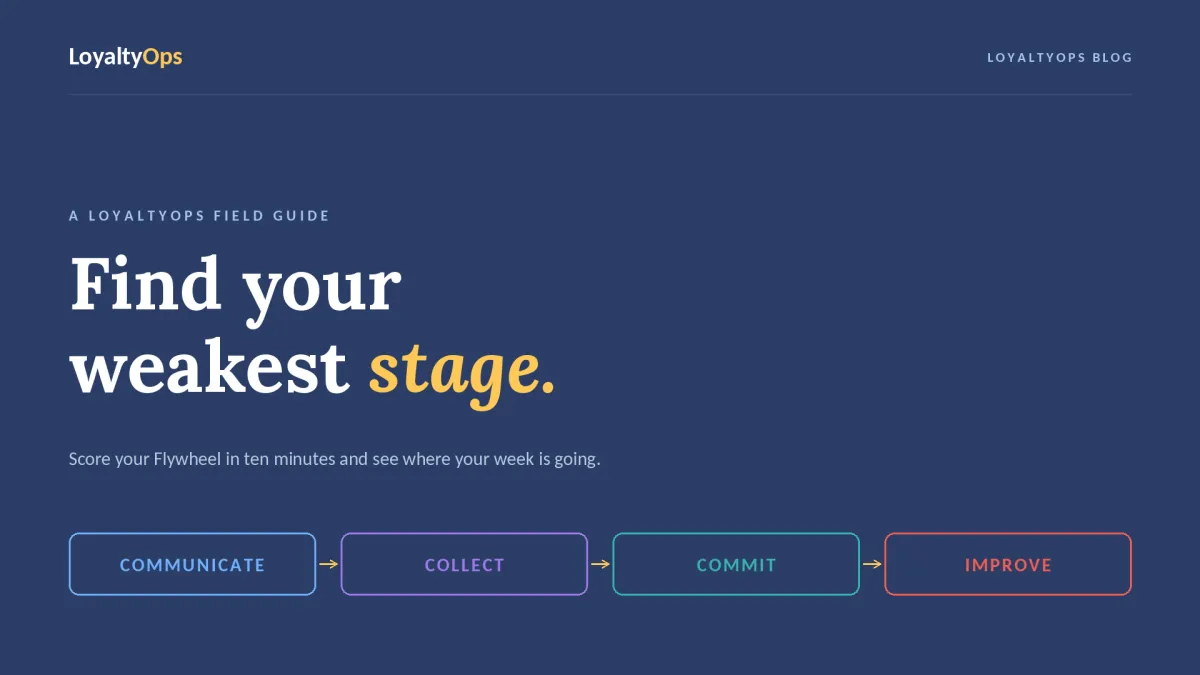
Leadership Operating Flywheel Guide: Free Download
The Leadership Operating Flywheel Guide: Find Your Team's Weakest Stage in 10 Minutes
If your week keeps filling up with decisions, rework, and problems you thought you'd already solved, there's usually one specific reason, and you can find it in about ten minutes. The free Leadership Operating Flywheel guide is the tool that helps you do it. Here's exactly what's inside and what you'll be able to do after you read it.
What is the Leadership Operating Flywheel guide?
It's a short LoyaltyOps field guide, ten pages, that lays out the four-stage system every team runs on and helps you find the one stage that's costing you the most right now. It's built for the leader of a small team who's still in the middle of every decision and wants the work to run without them, without micromanaging and without hiring their way out.
You can read it in one sitting and use it with your own team the same afternoon. No sign-up marathon, no course to work through, just the model and a way to put it to work this week.
What's inside the guide?
The guide walks through seven short sections:
The problem you keep hitting — the small signs that the way your team operates has started to break.
Why more effort hasn't fixed it — why more meetings, better people, and new tools don't close the gap.
The Flywheel, and why it works — the four stages and the tested methods behind them.
The four stages — Communicate, Collect, Commit, and Continuously Improve, each with a clear "good" and "breaking" read.
Find your weakest stage — a ten-minute self-score you fill in for your own team.
What changes when the Flywheel runs clean — the shift you're building toward.
Where this fits, and what comes next — how the four stages get built, one at a time.
The part most leaders act on first: the self-score
The center of the guide is a simple scoring table. You rate each of the four stages as running clean, some strain, or breaking, one stage at a time. It takes about ten minutes and it's honest work, because the stage you feel most as you read is almost always your weakest one.
Once you've found it, the guide gives you one move to run for that stage this week. A few examples from inside:
Commit: pick one decision your team made this month and name its single owner out loud, so it's clear to everyone.
Collect: recall the last time someone brought you hard news early and how you responded, then make it easier to do again.
Communicate: name one thing your team reads from your behavior that you didn't mean to send, and decide what you'll do differently.
Continuously Improve: name one mistake your team has made twice this year, and the one rhythm or checklist that could carry the lesson forward.
→ Get the free guide and score your team today: loyaltyops.com/leadership-operating-flywheel
A quick example: the self-score in action
Say you're the leader of a fifteen-person team. You read the four stages and, honestly, three of them feel fine. Communicate is solid, people know the direction. Collect is decent, you usually hear about problems in time. Continuously Improve is a little loose, but workable.
Then you hit Commit, and it lands.
Decisions get made in meetings, but the next step often floats without an owner. The same call about a client process has been remade three times this quarter. Priorities shift most weeks.
On the scorecard, you mark Commit as "breaking," and suddenly your week makes sense: the reason work keeps coming back to you is that ownership isn't clear, so people bring the call back to you to be safe.
Your move for the week comes straight from the guide: pick one decision your team made this month and name its single owner out loud, so it's clear to everyone. That's it. One stage, one move, and the heaviest part of your week starts to lift. That's how the guide is built to be used, one honest score and one small, visible change.
How do you use the guide with your team?
You can use it two ways, and both take under an hour.
On your own, read it through, score your four stages, and run the one move for your weakest stage this week. That's the fastest path, and it's how most leaders start.
With your team, share the four-stage read and ask each person to score the stages as they see them. You'll often find the team feels the same weak stage you do, which makes the fix easier to build because everyone already agrees on where the strain is. From there, you name the one move together and decide who owns it.
Either way, the guide is designed to be used the same afternoon you read it, not filed away for a planning offsite that never quite happens.
What will you be able to do after reading it?
By the end of the guide, you'll be able to name which of the four stages is weakest on your team, describe what "breaking" looks like there in plain terms, and run one concrete move to start building it, all before your next week begins. That's the whole point: not another framework to admire, but one clear next step for the exact place your week is leaking.
Who is the guide for?
It's for the capable leader of a growing team, roughly under thirty people, who has outgrown running everything in their head. If you're busy, your team is busy, and the work still comes back to you, the guide is built for your situation. It doesn't blame the team, because the team was never the problem; it helps you build the operations the team has grown past.
It's also a useful shared read for a leadership group that keeps hitting the same friction, because it gives everyone the same plain language for what's breaking and where to start. When a team can name its weakest stage together, the fix stops being one person's project and becomes something the whole team builds.
Download the Leadership Operating Flywheel guide
Find your team's weakest stage in ten minutes. → Download the free Leadership Operating Flywheel guide
Read it with your own team in mind, score your four stages, and run one move this week for the stage that's costing you the most. That's where the biggest improvement is.
→ Get the guide: loyaltyops.com/leadership-operating-flywheel
FAQ
Is the Leadership Operating Flywheel guide really free?
Yes. It's a free download at loyaltyops.com/leadership-operating-flywheel, with no course to buy and no strings. Read it once and you can use it with your team the same day.
How long does it take to use?
About ten minutes for the self-score, and one short read for the rest. You can find your weakest stage and pick your first move in a single sitting.
Do I need any special training or tools to use it?
No. The guide is written in plain language and the self-score is a simple table. You bring an honest read of your own team; the guide brings the model and the moves.
What happens after I find my weakest stage?
You run one move for that stage this week, using the prompts in the guide. From there, each of the four stages can be built with specific methods, two per stage, in the order that makes each one hold.
How is this different from a generic team health check?
A generic health check gives you a score. This guide gives you a cause. It names the four stages the work actually runs through, shows what breaking looks like at each, and points you to the one stage to build first, so you know what to do with the score.