
How to Hold Your Team Accountable Without Micromanaging
Why Your Team Keeps Missing Commitments (and How to Fix It Without Hovering)
Think about the last commitment that slipped on you. Someone said "I've got it," everyone moved on, and then the thing came in late, or came in wrong, or didn't come at all, and you found out with no time left to fix it. A risk that was clear to someone days ago never reached you. A miss got explained in careful detail when what you needed was a new plan. One by one, the unfinished commitments come back to you to chase.
The usual response is to watch more closely. Ask for more updates, check in more often, sit a little nearer to the work. It feels like the responsible thing, and it quietly turns you into the manager you didn't want to be. There's a better fix, and it starts with a different read on why commitments slip in the first place.
Why do commitments keep slipping?
Most of the time, it isn't that people don't care. It's that "I've got it" was never actually defined. When someone says they've got something handled, you both picture a result, a deadline, and a level of certainty, and there's no reason those pictures match. You heard a firm promise. They meant "I'll get to it." The words were the same, and the commitment underneath them was not.
When the standard for "I've got this" lives only in people's heads, each person carries a different version of it. Someone thinks flagging a risk early looks like panic, so they stay quiet and hope. Someone thinks a missed date isn't worth mentioning until you ask. None of that is bad faith. It's the predictable result of a commitment that was never made specific, and no amount of good intentions removes that mismatch on its own.
Why watching harder makes it worse
Here's the trap. When commitments slip, checking in more often does get you information, so it feels like it's working. But it also teaches the team that keeping track of the commitment is your job, not theirs. The more you chase, the less they carry, and you end up the person every unfinished commitment comes back to.
Micromanaging isn't a personality flaw, it's what a leader does when there's no shared standard for owning a commitment. Take the standard away and someone has to keep the whole thing in their head, and that someone is you. Add the standard, and the reason to hover mostly disappears, because the team is tracking their own commitments to an agreed bar.
It isn't that your team doesn't take ownership
You've probably already told the team to take ownership, and meant it. The trouble is that "own it" is an instruction people can't act on, because it doesn't say what owning a commitment actually looks like. Ownership in the abstract is a mood. Ownership defined as specific behavior is something a person can do on a Tuesday.
So a team that keeps missing commitments usually isn't a team that stopped caring. It's a team that never agreed what a real commitment is, when to raise a risk, and how to own a miss. That's a far easier problem to fix than motivation, because you can name a standard in an afternoon.
What "owning a commitment" actually means
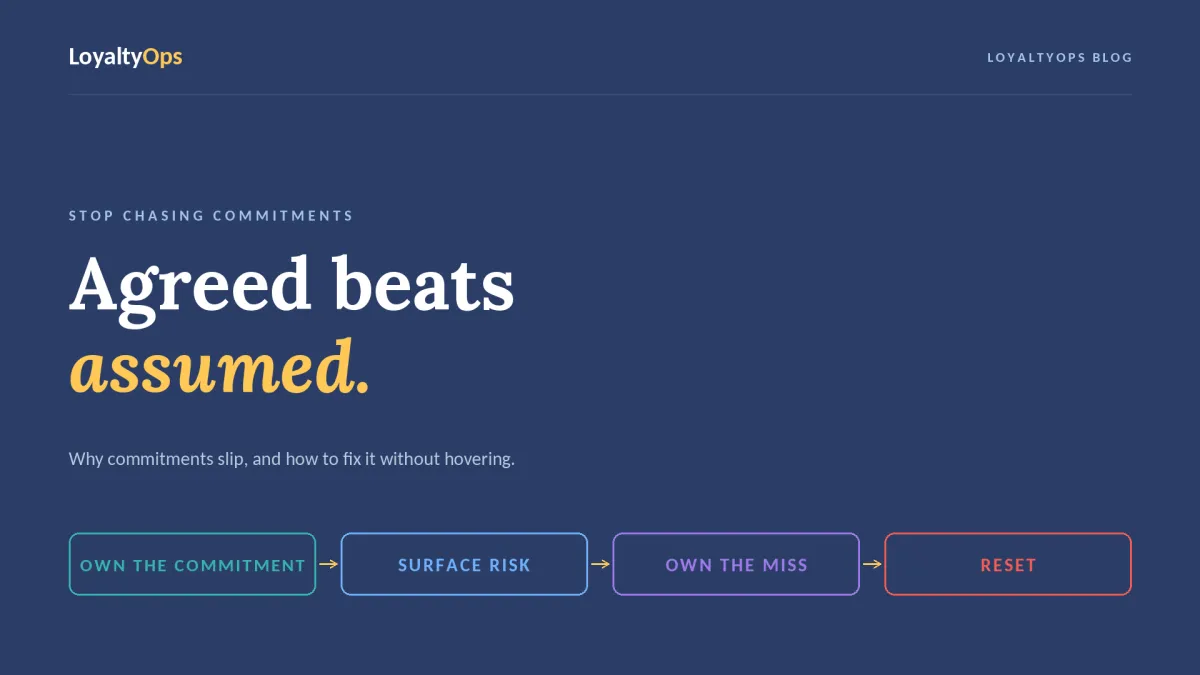
You get out of the cycle of chasing by making ownership explicit before anything goes wrong, instead of enforcing it after a miss. In practice, owning a commitment comes down to four agreed behaviors:
Own the commitment. A commitment is real only when the outcome, the owner, and the date are all clear. "I'll try," "I'll get to it," and "soon" aren't commitments, because none of them names those three things.
Raise risk early. Say something when your confidence drops, well before a miss is certain. An early warning is doing the job well, and the team treats it that way rather than as a failure.
Own the miss. Misses happen, and hiding them is what breaks trust. Keep it short and factual: "I missed this, here's the impact, here's what's next."
Reset. A miss leaves a gap, and the gap has to close. An apology isn't a plan, so the reset proposes a new date, a new owner, or the support that's needed.
Agree those four out loud, and "I've got it" stops being a hopeful phrase and starts being a specific promise everyone reads the same way.
The part that stops it all coming back to you
There's a second layer, and it's the one that actually stops the chasing being your job. Once each person owns their own commitments, peers can reinforce the standard with each other, so accountability runs between the team and not only through you. A colleague can ask "can we realign on what we agreed" without it turning into a fight, because the standard is agreed and the question is about the work, not the person.
That's the difference between a team you have to police and a team that holds each other to a standard it signed up for. You stay involved where you're genuinely needed, and the day-to-day chasing stops being yours to do.
How do you start this week?
Don't try to fix everything at once. Name one commitment this week as an owner, an outcome, and a date, out loud, so the team hears what a real commitment sounds like. The next time you miss one yourself, own it in front of them: "I missed this, here's the impact, here's what's next." When the leader models the standard first, it stops being a rule you enforce and becomes how the team operates.
Do that, and you're no longer holding the whole thing together by watching. You're holding it together with a standard everyone agreed to, which is the only version that survives a busy week.
Set one clear commitment this week
If you're tired of chasing commitments that quietly slipped, the fix isn't watching harder, it's agreeing what owning a commitment means. Our free Accountability Standards Builder walks you and the team through both layers — how each person owns a commitment, and how peers hold each other to it — and you agree to the standard and sign it together.
→ Download the free Accountability Standards Builder: loyaltyops.com/accountability-standards-builder
FAQ
How do I hold my team accountable without micromanaging?
Agree a shared standard for what owning a commitment means, instead of watching more closely. Define a real commitment as a clear outcome, owner, and date; agree to raise risk early, own misses plainly, and reset the plan after one. When the standard is agreed, the team tracks their own commitments to it and you no longer have to chase.
Why doesn't my team follow through on commitments?
Usually because "I've got it" was never defined, so each person means something different by it. One person hears a firm promise where another meant "I'll try." Naming what a real commitment is, and when to raise a risk, removes the guesswork that causes most slips.
Isn't telling people to "take ownership" enough?
No. "Own it" is an abstraction people can't act on. Ownership becomes real only when it's defined as specific behavior: name the outcome, owner, and date, raise risk early, own the miss, and propose a reset. Those a person can actually do; a mood they can't.
Doesn't accountability require consequences?
Consequences come up far less once expectations are agreed and it's safe to tell the truth early. Most misses are caught and reset before they become a problem when people raise risk early, which only happens when an owned miss is treated as professionalism rather than something used against them later.
How is this different from just checking in more?
Checking in more keeps the commitment in your head and teaches the team that tracking it is your job. An agreed standard puts the commitment in their hands and gives peers a calm way to hold each other to it, so accountability is shared across the team instead of resting on you.