
How to Build a Team That Runs Without You
How to Build a Team That Runs Without You, Without Micromanaging or Hiring
Your team is good. The people are capable, they work hard, and most weeks the work gets done. So why are you still in the middle of everything?
You approve the same kinds of decisions over and over.
Work you thought was settled comes back for another pass.
A problem you solved last quarter shows up again this quarter wearing a slightly different outfit.
The team is busy, you're busy, and the business is growing, but it's growing on your attention, and there's only so much of that to go around.
If that sounds like your week, the good news is that it isn't a people problem and it isn't a you problem. It's an operations problem, and operations can be built. Here's how to build a team that runs without you, one stage at a time.
Why does everything still come back to you?
When a team is small, you can hold it together in your head. You know what's happening on every project, you make the calls, and you catch the mistakes before they cost anything. That works, right up until it doesn't.
As the team grows, the number of decisions, hand-offs, and judgment calls grows with it. The habits that ran the work when you were five people can't carry the work when you're fifteen or twenty-five. Nothing broke on purpose. You just outgrew the way your team was set up to operate, and the gap shows up as work flowing back to your desk.
You can usually spot it in a few small signs:
Decisions you thought were made get reopened in side conversations.
Work that crosses team lines slows down or lands back with you.
Different people read the same standard in different ways.
The team talks about what to fix, and the same problems return next quarter.
None of those signs means anyone is doing a bad job. They mean the way your team operates hasn't caught up to the size of the team, and that's a fixable thing.
Why hasn't more effort fixed it?
Most leaders reach for the same three moves when the work starts coming back. Each one sounds right, and none of them closes the gap.
More meetings.
When things feel loose, adding a standing meeting feels like control. But a meeting doesn't fix the structure underneath it. It just spends more of the team's time managing the gap, and the gap stays exactly where it was.
Better people.
It's tempting to think the answer is a stronger hire. But capable people join the same way of operating, and within a quarter they're doing the same things everyone else does. If the operations don't change, the people can't either.
New tools.
A new project tool or dashboard can help, but the same tool used by two teams that operate differently still produces two different ways of working. The tool follows the operations, not the other way around.
The honest read is that the issue isn't how hard your team works. It's the system the work runs through. When that system has a weak spot, good people produce inconsistent results, and more effort can't make them consistent.
The four stages every team runs on
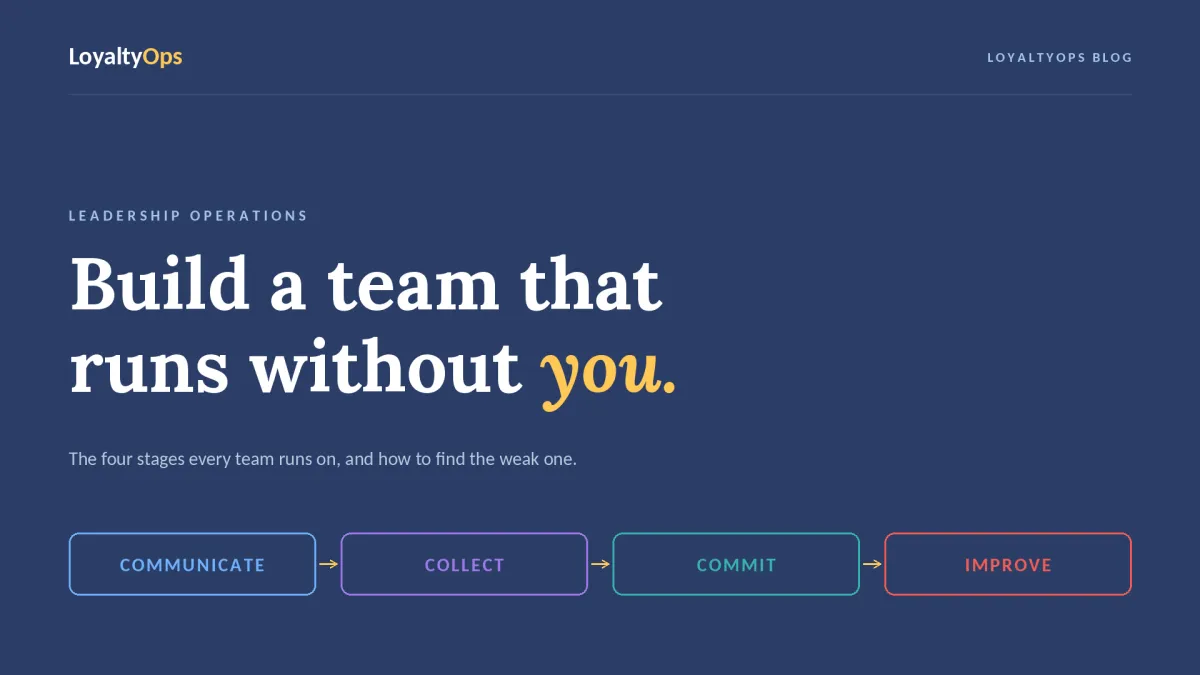
Underneath every team that runs well, the same four stages are working. We call them the Leadership Operating Flywheel, and your team already runs all four every day, whether you built them on purpose or left them to chance.
Communicate.
Your people know what the work is and what good looks like, clearly enough that they can act without checking with you first.
Collect.
What's actually happening in the work makes its way back to you. You hear about problems while they're still small.
Commit.
Decisions get made, and each one has a clear owner. The team knows which calls they can make and which few need you.
Continuously Improve.
What the team learns this month changes how it works next month. Lessons turn into habits the team keeps.
The Flywheel turns in one order, every time: Communicate, Collect, Commit, Continuously Improve, then back to Communicate. When all four are strong, the work moves, decisions get made close to the work, and the same problems stop coming back. When one is weak, you feel it as more of your week spent in the middle.
How do you find the one stage that's costing you the most?
Here's what we see with almost every capable leader we work with: three of the four stages are running fine, and one is weak. That single weak stage is where most of the week goes.
Each stage has a healthy version and a breaking one, and both are easy to recognize:
Communicate is breaking when people read the same standard in different ways, and decisions get reopened after you thought they were closed.
Collect is breaking when hard news reaches you late, and updates feel more polished than the reality underneath them.
Commit is breaking when decisions get made but no one owns the next step, and the same call gets made two or three times.
Continuously Improve is breaking when the team talks about what to fix and nothing actually changes, so the same issue returns in a new form.
A breaking stage shows up as the same problem, again and again, in slightly different clothing. Read the four descriptions and notice which one sounds most like your last month. That's almost certainly the stage to build first.
The reason this matters is that you don't have to fix all four at once, and trying to usually stalls the whole effort. Find the one stage that's taking up your week, build that one, and the whole Flywheel turns more cleanly.
What changes when your team runs without you in every decision?
When the Flywheel runs clean, the difference shows up fast:
Standards hold, because your behavior matches your words and people can act on the direction without a check-in.
Problems surface early, while they're still cheap to solve, instead of landing on your desk after they've grown.
Accountability gets calm. It becomes normal and shared, the kind the team holds without it feeling personal.
Decisions move, made by the people closest to the work, with you in only the few that truly need you.
Effort compounds into growth, quarter over quarter, so the growth you've been working toward is what the business actually reaches.
The picture is simple: the operations stay with the team, the work stops coming back to you, and the company gets sharper as it grows.
Where should you start this week?
You don't need a reorganization or a new tool. You need ten minutes and one honest question: of the four stages, which one is costing me the most right now?
Once you've named it, run a single move for that stage this week. If it's Commit, pick one decision the team made this month and name its single owner out loud. If it's Collect, think about the last time someone brought you hard news early, and make it easier to do that again. Small, visible moves are how the Flywheel gets built, one stage at a time.
Find your team's weakest stage this week
Want to find your team's weakest stage today?
Our free Leadership Operating Flywheel guide walks through all four stages, shows you the healthy and breaking version of each, and includes a ten-minute self-score so you can see exactly where your week is going. It's a short read, and you can use it with your own team the same afternoon.
→ Download the free Leadership Operating Flywheel guide: loyaltyops.com/leadership-operating-flywheel
Frequently Asked Questions
Why does my team keep coming to me for every decision?
Usually because the "Commit" stage of how your team operates is weak. Decisions get made but ownership isn't clear, so people bring the call back to you to be safe. Naming one owner for each decision is the fastest way to start closing that gap.
How do I get my team to run without me without losing quality?
Quality holds when standards are clear and your behavior matches them, not when you personally check every piece of work. Build the four stages of the Flywheel — clear communication, honest collection of what's happening, clear ownership of decisions, and steady improvement — and the quality bar stays high without you in the middle.
Is my team disorganized, or is it me?
Neither. When a team feels disorganized, it's usually not the people or the leader, it's that one stage of how the team operates was never built to hold on its own. The team feels the strain from the inside, and the real cause is a single weak stage you can find and build.
How long does it take to build a team that runs without you?
It starts the week you find your weakest stage and run one move for it. Building all four stages so they hold takes longer, but the shift is noticeable quickly, because fixing the one stage that's costing you the most frees up the biggest part of your week first.
What's the difference between delegating and building operations?
Delegating hands off one task. Building operations changes the system so hand-offs, decisions, and standards work the same way every time, without you re-explaining them. Delegation is a moment; operations is what makes delegation stick.