
Closed-Loop Communication: The Back Briefing Habit
Everyone Nodded. Nobody Understood.
In a hospital, a nurse repeats a medication order back to the doctor before giving it. In a cockpit, the first officer reads an instruction back to the captain. Both are using the same technique, called closed-loop communication, and both do it for the same reason: a message isn't confirmed until the receiver says it back and the sender confirms it. Leaders rarely bring that discipline into their own teams, which is why work so often comes back wrong even after a clear conversation. Back Briefing is closed-loop communication for the everyday work of leading a team, and here's how it works.
Everyone nodded, and the work still came back wrong
You had the conversation. You explained the priority, set the deadline, named the decision, and asked if there were questions, and no one had any. Then the work comes back wrong: the deadline meant something different to them, the priority got read two ways, the decision means one thing to you and another to the person doing it. Nobody pushed back in the room, so everyone assumed they were aligned. The gap was there the whole time, and it showed up later as rework, a missed deadline, and the cost of doing it twice.
Why explaining it again won't close the gap
The natural fix is to explain more: a longer brief, the priorities repeated, one more "does anyone have questions?" And you still end up with the same gaps. The reason is simple: hearing you explain something is not proof that the other person understood it the way you meant it. People nod because they believe they understood, and they usually did understand something, just not always the same something you were picturing. The only way to know for sure is to hear them say it back to you.
The one-minute habit: ask them to play it back
Back Briefing is a short check you run right after a decision, a priority, or a request. Rather than trust the nod, you ask the person taking on the work to play back their understanding in their own words, and you listen for the gap. The whole habit comes down to one question:
What do you understand the decision, priority, or next step to be?
A good playback covers four things: the request said back in their words, the outcome you're both aiming for, the next step they'll take, and who owns it by when. In practice it costs about a minute, and that minute catches gaps that would otherwise cost hours or days of rework.
Spoken or written, whichever the moment calls for
The question is the whole tool; the format follows the moment. Most of the time it's spoken, right at the end of a conversation, with a line as simple as "before we wrap, can you play back your understanding, so I know I was clear?" For higher-stakes or async work, put it in writing: a few bullets in an email or message that both of you can point to later, covering your understanding of the request, the outcome, the next step, the owner and timing, and what success looks like. If the written version takes more than two minutes to write, it's too long.
Use it where a gap would cost you the most
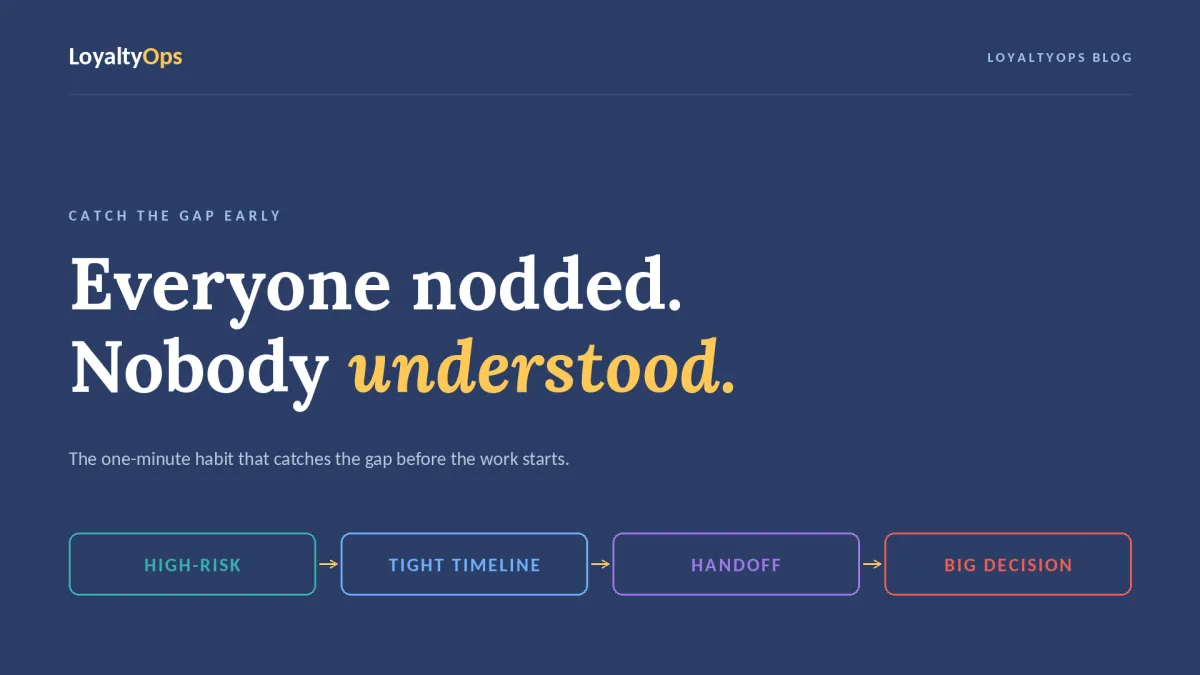
Back Briefing isn't for every exchange, and running it everywhere would just be noise. Use it at the moments where being misread is expensive. Four cover most cases:
High-risk delegation. The work is complex or high-stakes, and costly if it's misread.
Tight timelines. There's no room to redo the work before the deadline.
Cross-functional handoffs. The work moves between teams, departments, or functions.
Strategic decisions. One decision will shape many that follow.
Keep the rule tight, because the value is in knowing exactly when it applies and using it there. It's a habit and a one-minute check, not a document and not extra admin.
How you respond decides whether it lasts
One thing decides whether the habit lasts: how you react when the playback surfaces a gap. That gap was in your original ask, so it's yours to own. Take it calmly and clarify, with something like "thank you, that's on me, let me clarify." If you treat the playback as a test the person failed, with something like "weren't you listening, I just explained this," they'll stop playing work back to you, and you'll lose the clarity check at the very moment you need it most.
Owning the gap yourself is what keeps it safe for people to keep playing back the next one. The habit only survives in a place where being honest about a misunderstanding is treated as useful, not as a failure. That's the quiet reason the habit works: it doesn't just check understanding, it makes clarifying a normal, low-stakes thing to do.
Where Back Briefing fits
Back Briefing is one of the operational tools of the Leadership Operating Flywheel, the four-stage system your team runs on. It's part of how the Communicate stage works in practice, the point where what you intended actually reaches the person doing the work, unchanged. It works best alongside the others: a team that shares one direction, brings problems forward early, and knows how decisions get made. Each of those tools strengthens the rest, and together they're what lets the team run without you in every decision. On its own, this one habit tends to pay for itself the first time it catches a misread on high-stakes work, which is usually within the first week of using it.
Download the free Back Briefing Guide
We put the whole habit into the Back Briefing Guide: the one question, the four moments to use it, what a good playback covers, a short written back-brief format for higher-stakes work, and the exact words to use when a gap shows up so the habit lasts.
→ Download the free guide: loyaltyops.com/back-briefing
If you want to build habits like this alongside a room of other leaders working on the same thing, that's part of the work inside the Leaders Mastermind.
FAQ
What is closed-loop communication? It's a communication technique, used widely in healthcare and aviation, where the receiver of a message repeats it back and the sender confirms it, so both know it was understood the same way. Back Briefing brings the same idea to everyday leadership: you ask the person to play back their understanding before the work starts.
What is Back Briefing? Back Briefing is a one-minute habit: right after a decision or request, you ask the person taking on the work to play back their understanding in their own words, so you can catch any gap before anyone builds on it. The whole habit comes down to one question and a minute of listening.
How do I confirm someone understood without sounding like I'm testing them? Frame it as checking your own clarity, not theirs. A line like "before we wrap, can you play it back so I know I was clear?" puts the responsibility on you. And when a gap shows up, own it as yours, which keeps the habit safe to keep using.
When should I use Back Briefing? At the moments where being misread is costly: high-risk or complex delegation, tight timelines with no room for rework, cross-functional handoffs, and decisions that will shape many others. Using it everywhere is noise; using it at those four moments is where it pays off.
What should a good playback include? Four things: the request said back in the person's own words, the outcome you're both aiming for, the next step they'll take, and who owns it by when. If any of those doesn't match what you meant, you've found the gap, and you close it in a sentence.