
The Accountability Standards Builder: Free Template
The Accountability Standards Builder: Agree the Standard, Sign It Together
If commitments keep slipping and every unfinished thing comes back to you to chase, the fix is to agree what owning a commitment means, in writing, and have the team sign up to it together. The free Accountability Standards Builder gives you a simple, repeatable way to do exactly that. Here's what's inside and how to run it this week.
What is the Accountability Standards Builder?
It's a short LoyaltyOps builder and worksheet that turns "I've got it" into a standard your team actually agrees to. It walks you through the two layers of accountability — how each person owns a commitment, and how peers hold each other to the standard — and ends with a page the team signs, so the standard is agreed rather than assumed.
It's built for the leader who's tired of chasing commitments and doesn't want to become a micromanager to fix it. You can draft the standard with your team in one working session.
What's inside the Builder?
The Builder walks through the whole method:
The two layers — self-accountability first, then mutual accountability.
Four self-accountability standards — what owning a commitment means, in behavior and words.
Five mutual-accountability standards — how peers reinforce the standard, including safe language.
The four ways to make it safe — so people tell the truth early.
A worked example — a real commitment, a non-commitment, and a clean miss, side by side.
A sign-off page — where the team agrees to the standard and signs it together.
Layer one: the four self-accountability standards
Self-accountability is how each person owns a commitment before anyone else has to get involved. You write each standard in your team's own words and agree to it together.
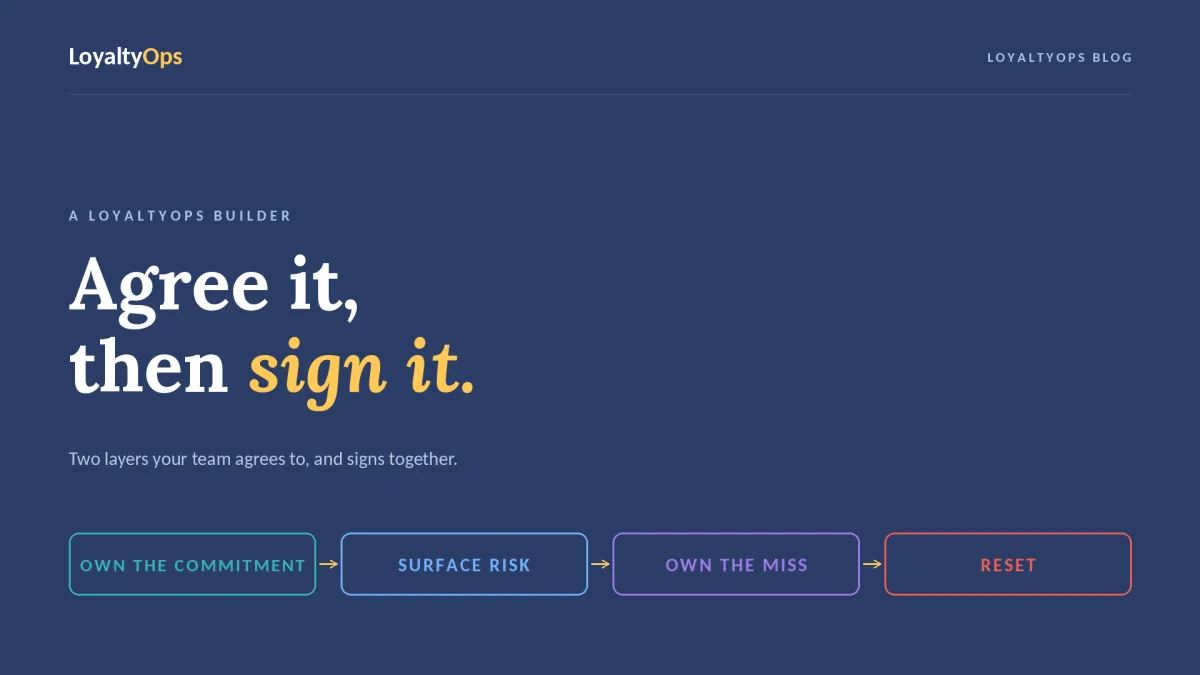
Own the commitment — a commitment is real only when the outcome, the owner, and the date are all clear. "I'll try" and "soon" don't count.
Surface risk early — raise a risk when your confidence drops, well before a miss is certain, and the team treats that as doing the job well.
Own the miss — keep it short and factual: "I missed this, here's the impact, here's what's next."
Reset the plan — a miss leaves a gap, and the gap has to close, so propose a new date, a new owner, or the support you need.
Layer two: the five mutual-accountability standards
Once each person owns their own commitments, the team reinforces the standard with each other, so accountability runs across peers and not only through you. The Builder gives you five agreements: what you hold each other to, when you speak up versus escalate, how you do it (about the work, not the person), the safe language you'll use, and what you rule out.
The safe language that makes it usable
The standard most teams skip is safe language, and it's the one that makes peer accountability actually happen. A few agreed phrases give a colleague a calm, expected way to raise the standard without it turning tense. "Can we realign on what we agreed" is a good starting phrase; the Builder asks your team to agree on two or three of its own. With shared words in hand, speaking up stops feeling like starting a conflict and starts feeling normal.
A worked example
The Builder shows you the difference between a commitment and a hopeful phrase, so the standard is concrete. Here's the worked example from the tool:
A real commitment: Owner Priya, outcome "client plan draft sent," by Thursday 3 pm.
Not a commitment: "Priya is on it."
A clean miss: "I missed the Thursday draft, the client review slips a day, I'll have it by Friday noon."
Read side by side, the difference is obvious: the real commitment names an outcome, an owner, and a date, and the clean miss names the impact and the reset. That's the bar the whole team agrees to.
The four ways to make it safe
None of these standards work unless it's safe to tell the truth early, so the Builder includes the four practices that create that safety. Separate the miss from the person and never use an owned miss against someone later. Reward the early warning out loud. Normalize the miss, so a fast reset is the expected response. And make challenge welcome, so a peer raising the standard is received as help. Skip these, and people go quiet; keep them, and problems reach you while there's still time to act.
How to run it this week
Block one working session with the team. Walk through each layer, write each standard in your own words, and agree the safe phrases you'll use. Then sign the page together, so the standard is a shared agreement rather than a document you sent around. Start living it immediately: the leader names one real commitment and, at the next miss, owns it in front of the team. A standard the team agreed to and watched you model is one that stays in place.
Who is the Builder for?
It's for the leader whose team keeps missing commitments, who wants reliability without hovering over everyone. If "I've got it" keeps meaning different things and the unfinished commitments come back to you to chase, the Builder gives you a structured, low-effort way to agree the standard and get the team holding each other to it. It isn't a policy to enforce; it's a standard the team signs.
Get the Accountability Standards Builder
Turn "I've got it" into a standard your team agrees to and signs. → Download the free Accountability Standards Builder
Block one session, walk the two layers, write each standard in your own words, and sign it together. That's how you stop chasing commitments and start running a team that holds itself accountable.
→ Get the Builder: loyaltyops.com/accountability-standards-builder
FAQ
Is the Accountability Standards Builder really free?
Yes. It's a free download at loyaltyops.com/accountability-standards-builder, with no course to buy. You can draft the standard with your team in one working session.
What will I get?
The two-layer method, the four self-accountability standards, the five mutual-accountability standards including safe language, the four ways to make it safe to tell the truth, a worked example, and a sign-off page the team agrees to together.
What are the two layers of accountability?
Self-accountability (how each person owns a commitment: outcome, owner, date, raise risk early, own the miss, reset) and mutual accountability (how peers reinforce the standard with each other using agreed, safe language). Self-accountability comes first.
How is this different from a team working agreement?
A working agreement usually covers how you meet and communicate; the Accountability Standards Builder focuses specifically on commitments — what a real one is, how you warn early, how you own a miss, and how peers hold each other to it. You can use both; this is the accountability piece.
How do I keep the standard from being ignored after we write it?
Sign it together and have the leader model it first. Name one real commitment out loud, own your own next miss in front of the team, and reward early warnings. A standard the team agreed to and watches you live is the version that stays in place.